
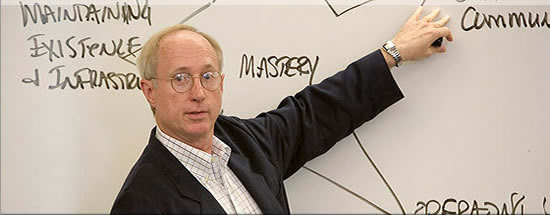
Jeffrey teaching Performance Star
Professor Ford is Jeffrey D. Ford, Associate Professor of Management in the Fisher College of Business at The Ohio State University. I am the co-author (with my wife Laurie) of The Four Conversations: Daily Communication that Gets Results and Deadline Busting: How to be a Star Performer in Your Organization. I train managers and executives in how to be more effective by shifting their focus from changing the attributes and characteristics of individuals (or groups) to building the reliability of the transactions that occur “in between” individuals (or groups). And, to do this through the use of conversations that make a difference and that build effective working relationship by developing greater credibility, trust, accountability, and accomplishment.
As a management professor for over 30 years, I have had the opportunity to work with thousands of truly great managers in the classroom and in the workplace. In that time, I have come to the conclusion that we have made management more complex without adding a corresponding level of value. The literature on management and leadership is so extensive that it is impossible for any practicing manager to comprehend it, let alone master it. As Barry Schwartz points out in his book The Paradox of Choice (see his TED presentation), the more choices we have, the less satisfied we are. In management, it seems the more choices we have, the less effective we become. Why? Because most of us don’t really practice any of them to the point of real proficiency. As a result, we have become addicted to the next newest tip or idea as if knowing it will be the key to success and relieve us of the need to practice, practice, practice. In this respect, we forget that conceptual knowledge is not the same as practical knowledge.
As a result of this observation (conclusion?), I have taken a much different approach to management education and this blog.
For the past 20 years I have worked to identify what might be considered the core elements of effective management. By management, I mean getting things done with and through the contribution of others. At its heart, management is about performance and what it takes to create and sustain it. The core elements of management are those few things, which if done well, make it possible to reliably generate, maintain, and change performance – our own and that of others. Management is not theoretical, it is very practical. It happens in the daily interactions of people, in what they say and don’t say, in what they do and don’t do.
I believe that management is fundamentally simple, though it is not necessarily easy (you are dealing with people after all). By simple I mean there are only a few core principles that are needed to be effective in the day-to-day arenas of work. But implementing these core principles is not easy, it takes work to be good at them. But, as I have seen in my work with managers, the rate of return on the investment made in implementing these principles is high and fast. Little changes can produce significant and immediate returns. This blog is about developing these core principles.
The Performance Star
The five core principles, which are described below, constitute what I call the Performance Star. The Performance Star indicates that the five principles work together and that in order to progress to a higher level in performance, it is necessary to upgrade each area so that they support the higher performance. In the absence of these upgrades, there can be momentary increases in performance, but the increases cannot be sustained for long periods. It has been my observation that these principles apply to individual as well as group performance.
THE PERFORMANCE STAR

The elements of the Performance Star:
1. Focus on Deliverables and Outcomes
Management is fundamentally about delivery. A successful manager promises to deliver certain results, and ensures that they receive relevant deliverables from others inside and outside their organization. Management is not just about “doing” – though that matters – it is about the deliveries of results and communications that are the products of that “doing”. From a management perspective, delivery is the senior phenomenon, and gives meaning and direction to “doing”.
2. Manage Existence and Infrastructure
This is the “existence foundation”, underscoring the necessity of keeping promises present, visible, and actionable for everyone involved in their fulfillment. No one can work on, execute, or deliver something that does not exist. To be successful, we must invent and use “existence systems” (e.g., “To Do Lists”) that keep our agreements and promises in existence, and fully support us in completing whatever we have agreed to do or deliver. Existence systems include, at least, (a) personal work practices that ensure reliable capturing of promised deliverables, (b) effective individual and group scheduling, calendaring and tickler systems, and (c) organization structures such as reporting mechanisms and meeting agendas. The challenge is to create these and then to maintain them so that they allow for current and expanded execution.
3. Communicate Committedly
Getting anything done depends on our ability to communicate. This element says that talk makes things happen, but the only talk that really matters is committed talk. To be effective, talking about work, deliverables, agreements, and other results must be accompanied by a genuine commitment to the successful execution of promises. Committed communications include communications for building necessary relationships, increasing everyone’s understanding of agreements and expected outcomes, and recognizing the status and progress of desired accomplishments by using the four conversations – initiative, understanding, performance, and closure.
4. Be Accountable
Accountability, also referred to as personal responsibility, is about how we relate to the world in general and our work in particular. Accountability is about ownership. When we are accountable, we operate in a responsible (causative) manner to ensure that things get done. We actively seek the resources, have the necessary communications, and get whatever is needed. When we are accountable, we “own” the work we have to do and relate to it as something we have chosen. The opposite of being accountable is being a victim.
5. Operate With Integrity
Operating with integrity is about our relationship to our spoken word. When we are operating with integrity, we do what we say we will do, and in the event of failure, acknowledge it and handle the consequences for ourselves and others. When operating with integrity, we are responsible for our agreements with others, and repair broken agreements whenever they happen.